
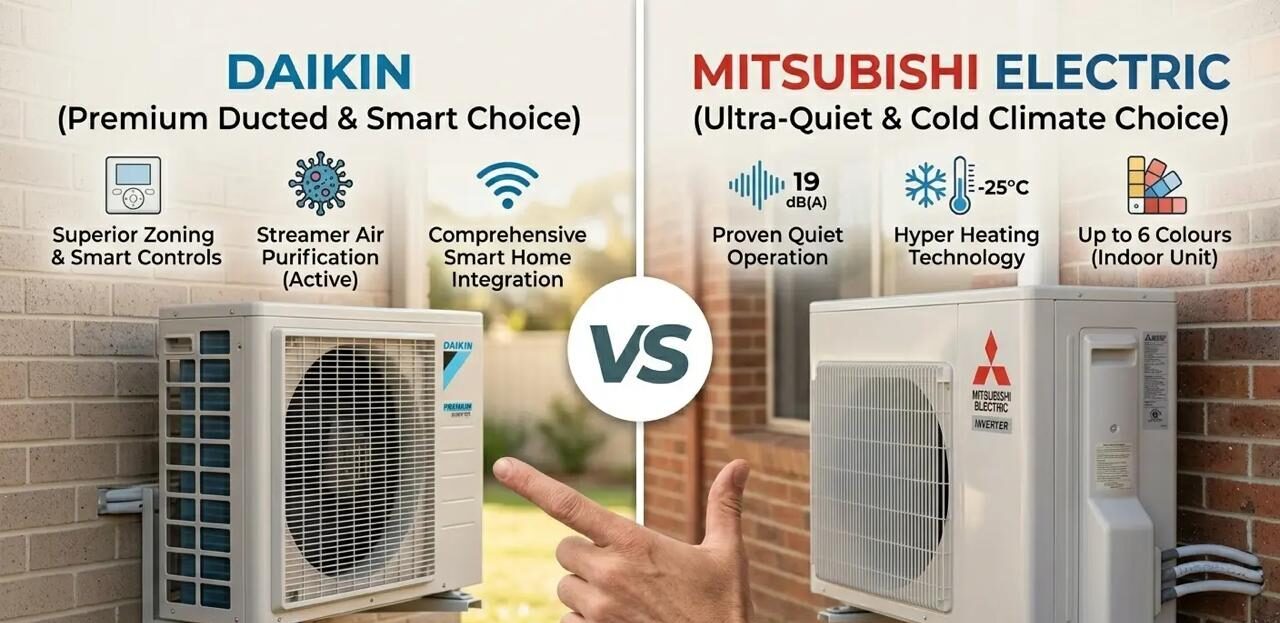
Daikin and Mitsubishi Electric are two of the most respected air conditioning brands in Australia.
Whether you are comparing daikin versus mitsubishi AC for a bedroom, researching the best split system for a whole home, or deciding between mitsubishi vs daikin aircon for a new build, both brands deserve serious consideration. This guide gives you an honest comparison across every factor that matters, with no brand loyalty involved.
Mitsubishi vs Daikin at a Glance
| Category | Best Choice | Why |
|---|---|---|
| Best premium ducted system | Daikin | Superior zoning, smart controls, wider range |
| Quietest operation | Mitsubishi Electric | MSZ-LN 19 dB(A), ultra-quiet reputation |
| Best smart home integration | Daikin | More comprehensive app and third-party support |
| Best air purification | Daikin | Streamer technology actively destroys allergens |
| Best colour variety | Mitsubishi Electric | Up to 6 colour options on MSZ-LN |
| Best energy efficiency | Daikin Perfera | Top star rating at equivalent capacities |
| Best mid-range value | Mitsubishi MSZ-AP | Proven quality at lower supply cost |
| Best cold climate heating | Mitsubishi Electric | Hyper Heating operates to -25 degrees Celsius |
| Best long-term whole-home | Daikin | Installer network, zoning, longevity |
Daikin vs Mitsubishi Ducted Air Conditioning Systems
Air conditioning reviews from Australian homeowners on both brands from Australian homeowners are consistently positive, particularly on longevity and cooling performance.
- Daikin ducted systems are widely regarded as the stronger option in Australia, due to their zoning capability, smart control integration, and breadth of system sizes make them the leading choice for new builds and upgrades.
- Mitsubishi Electric ducted air conditioning is also a reliable, capable choice.
The distinction is not reliability but depth of zoning and smart control capability.
For homeowners comparing split systems for individual rooms, both brands offer strong options at the premium end. Explore Tempco’s split system range here.
Mini Splits and Multi-Head Systems
When comparing the daikin vs mitsubishi split system, both brands offer reliable multi-head options for homes where ducted installation is not practical.
When homeowners compare mitsubishi vs daikin split system or ask which is the better daikin mini split vs mitsubishi option, the honest answer is that both brands are strong at the mini split level. The same applies when comparing the daikin heat pump vs mitsubishi in a multi-head configuration. Brand comes second to correct sizing and installation quality.
- Mitsubishi Electric’s multi-head range is capable, and the MSZ-LN indoor units retain their quiet-operation advantage in a multi-split configuration.
- Daikin multi-split systems support multiple indoor units from a single outdoor unit, with zoning controlled at each head.
Explore Tempco’s ducted gas heating options for whole-home heating solutions.
| Quick Tip: For most Australian homes, a properly sized single ducted system will outperform a multi-head setup in both efficiency and comfort. Multi-splits are best suited to homes where ductwork is not feasible. |
Heating Performance: Daikin vs Mitsubishi Heat Pump and Reverse Cycle System
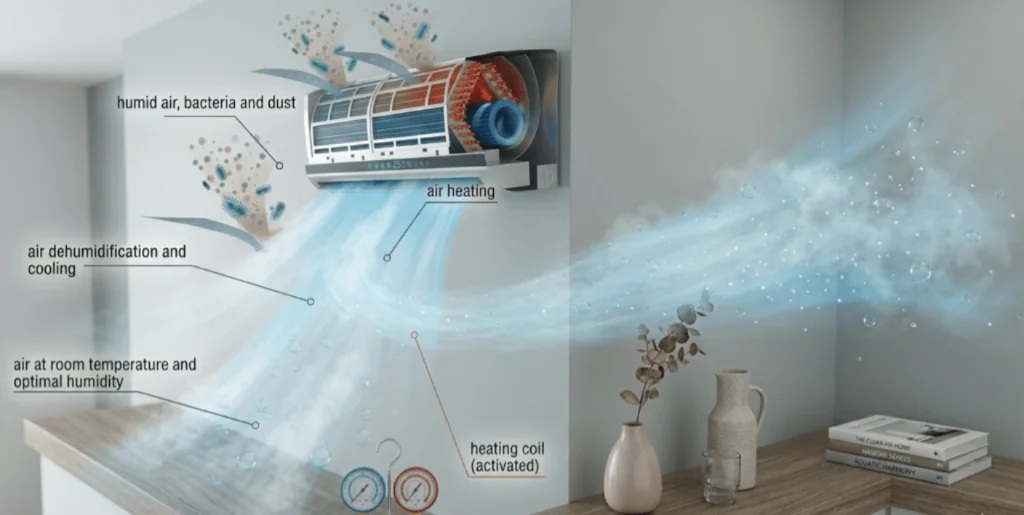
Both brands are reverse cycle systems using inverter-driven heat pump technology. When comparing a daikin vs mitsubishi heat pump for Australian conditions, performance in cold weather becomes a key differentiator.
- Mitsubishi Electric’s Hyper Heating technology is a standout feature. The MSZ-LN series maintains full rated heating output down to -25 degrees Celsius outside, the best rated cold-weather performance among mainstream residential split systems in Australia.
- Daikin’s systems are rated to approximately -20 degrees Celsius, which is more than adequate for most Australian conditions including the Southern Highlands and Canberra region.
For the vast majority of Australian homeowners, the difference between -20 and -25 degrees Celsius will never be felt in practice. It only becomes relevant in extreme alpine conditions or unusually severe winter events. Explore Tempco’s ducted reverse cycle system options.
Energy Efficiency
Both brands use inverter technology, adjusting compressor speed in real time rather than cycling on and off is the foundation of low running costs in modern residential air conditioning.
- The Daikin Perfera series leads the Australian market at equivalent capacities, with a SCOP (heating efficiency) of 5.1 and SEER (cooling efficiency) of 9.0.
- The Mitsubishi Electric MSZ-LN is close behind at SCOP 4.7 and SEER 8.8, which is still an excellent result.
For ducted systems, efficiency depends heavily on system sizing, zoning design, and installation quality. A correctly zoned and installed Daikin or Mitsubishi Electric ducted system will significantly outperform an oversized, poorly installed system from either brand.
| Quick Tip Running Costs Running costs for a modern inverter reverse cycle system are often lower than homeowners expect. Smart zoning and correct sizing matter as much as the brand itself. See Tempco’s ducted gas heating cost guide to compare heating and cooling costs across system types. |
Noise Levels
For outdoor unit noise, both brands are comparable at similar capacities. If outdoor noise matters, ask your installer for the specific outdoor unit rating for the model you are considering.
| System | Indoor Noise | Verdict |
|---|---|---|
| Daikin Perfera (FTXM-R) | 19 dB(A) | Outstanding for bedrooms |
| Daikin Stylish (FTXA) | 19 dB(A) | Outstanding for bedrooms |
| Daikin Emura (FTXJ) | 22 dB(A) | Very quiet, slight step up |
| Mitsubishi MSZ-LN (Premium) | 19 dB(A) | Outstanding for bedrooms |
| Mitsubishi MSZ-AP (Mid Range) | 20 dB(A) | Very quiet for the price |
| Mitsubishi MSZ-EF (Lifestyle) | 22 dB(A) | Very quiet, design focus |
At the premium level, both Daikin and Mitsubishi Electric match at 19 dB(A), which is genuinely near-silent in a standard room.
Mitsubishi Electric’s overall reputation for quiet operation comes from the breadth of their range performing well, not just the flagship.
Smart Controls and Home Integration
Smart control has moved from a premium feature to an expectation for most Australian homeowners buying a new system in 2026.
- Daikin’s smart control ecosystem is more comprehensive. Wi-Fi is built into most residential units, with app-based scheduling, energy monitoring, and compatibility with Google Home, Amazon Alexa, and other smart home platforms.
- Mitsubishi Electric’s MELCloud app provides solid scheduling, remote control, and energy monitoring across all Wi-Fi enabled models. Third-party smart home integration is more limited compared to Daikin.
For homeowners building or upgrading a smart home setup, Daikin offers meaningfully better integration. For homeowners who simply want to control their aircon from a phone, both brands deliver the basics well.
Air Purification Technology
Air quality is a growing priority for Australian homeowners.
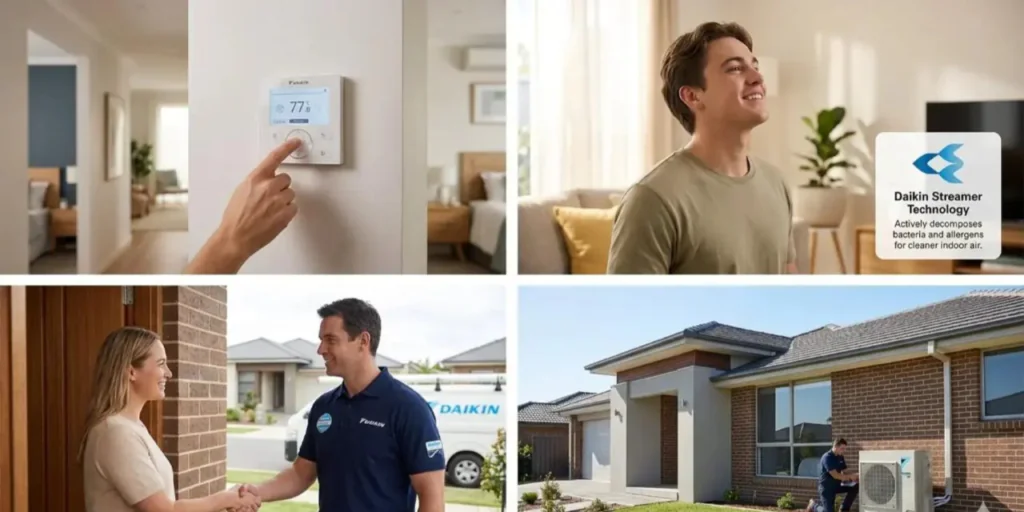
- Daikin’s Streamer technology is the key differentiator here. It generates high-speed electrons that actively decompose allergens, bacteria, mould, and fine dust at a molecular level, rather than simply trapping particles in a filter. The Streamer unit works continuously alongside normal filtration.
- Mitsubishi Electric provides effective standard filtration across their residential range, capturing dust and larger particles. They do not include active purification technology equivalent to Daikin Streamer in their standard Australian residential lineup.
| Quick tip: For households with asthma, hay fever, or other respiratory conditions, Daikin’s air purification advantage is a genuine, measurable benefit. |
Daikin vs Mitsubishi Reliability and Lifespan
For both brands, the single most important factor in reliability is installation quality. A correctly designed, correctly sized, and professionally installed system from either brand will significantly outlast a rushed or undersized installation.
Mitsubishi air conditioner reviews in Australia frequently highlight how well the systems hold up over time, with minimal component failure and consistent performance. The same is true for daikin aircon reviews across the installer and homeowner community.
Daikin aircon reviews from Australian homeowners and tradespeople are equally strong. Daikin systems installed correctly by authorised dealers have a well-documented track record of long-term performance.
Tempco provides ducted gas heating installation, servicing, and maintenance across regional Australia.
Maintenance and Servicing
Both Daikin and Mitsubishi Electric systems require the same basic maintenance routine.
Daikin has a stronger authorised service network in regional Australia, which matters for homeowners in the Southern Highlands, Goulburn, and surrounding areas.
Mitsubishi Electric parts and service, reliably available in metropolitan areas, with slightly longer lead times in regional areas.
Running Costs
Daikin’s Perfera series has a marginal efficiency advantage over the Mitsubishi Electric MSZ-LN at equivalent capacities. Over a 10-year ownership period, this difference translates to a modest but real saving on electricity bills.
A fully ducted system serving a whole home will cost more in absolute terms but delivers better whole-home comfort and efficiency than running multiple standalone units.
For a detailed comparison of heating and cooling running costs across different system types, see Tempco’s ducted gas heating cost guide.
Warranty and After-Sales Support
Both Daikin and Mitsubishi Electric offer 5-year parts and labour warranty for residential systems installed by an authorised dealer, contingent on system registration after installation.
- Daikin’s after-sales infrastructure in Australia is particularly strong, with parts availability covering regional areas effectively.
- Mitsubishi Electric’s national service network is limited across metropolitan Australia.
Why Does Daikin Often Cost More, is Daikin Better Than Mitsubishi?
Daikin systems carry a slightly higher supply price than equivalent Mitsubishi Electric models in most product categories. Here is what that premium delivers:
- Streamer air purification technology, actively eliminating allergens and bacteria rather than passively filtering
- More advanced ducted zoning and smart control options, better suited to whole-home comfort systems
- Higher peak energy efficiency in the Perfera series, with measurable long-term running cost benefits
- Daikin’s authorised installer program provides additional accountability and training standards for installation quality
Daikin vs Mitsubishi Electric: Full Comparison
| Feature | Daikin | Mitsubishi Electric |
|---|---|---|
| Energy efficiency (split) | Very high (Perfera SCOP 5.1) | High (MSZ-LN SCOP 4.7) |
| Indoor noise | 19 dB(A) (Perfera and Stylish) | 19 dB(A) (MSZ-LN), 20 dB(A) (MSZ-AP) |
| Indoor unit depth | 267mm (Perfera) | 210mm (MSZ-LN, slimmer) |
| Colour options | 3 (most series) | Up to 6 (MSZ-LN) |
| Air purification | Streamer (active, destroys allergens) | Standard filtration (passive) |
| Smart home integration | Strong, app + third-party | MELCloud app, fewer integrations |
| Ducted range | Comprehensive, strong zoning | Solid, slightly more limited |
| Heat pump low-temp heating | Effective to approx. -20 C | Hyper Heating to -25 C |
| Warranty (authorised install) | 5 years parts and labour | 5 years parts and labour |
| Installer network (AU) | Very strong, including regional areas | Good, stronger in metro areas |
| Price point | Mid to premium | Low to Premium |
| Running costs | Very low (Perfera) | Low (MSZ-LN) |
| Best use case | Whole-home ducted, smart integration | Quiet rooms, design buyers, cold climates |
If you are comparing reverse cycle heating against gas heating for your home, this guide: is ducted heating gas or electric covers the full breakdown.
Final Summary: Daikin vs Mitsubishi which is better
Both are premium Japanese brands and genuinely excellent choices for Australian homeowners. Neither is a poor decision.
If you are choosing a split system primarily for a quiet bedroom or want the widest colour selection for a design-focused space, Mitsubishi Electric’s MSZ-LN is one of the best residential split systems available in Australia.
For whole-home ducted comfort, advanced air purification, smart home integration, and long-term performance backed by Australia’s strongest HVAC installer network, Daikin is the preferred premium choice. Daikin premium generally delivers a meaningful return over a 10 to 15 year ownership period through better integration, lower running costs, and stronger local support.
Expert Advice for Australian Home-owners
Tempco Energy has been supplying and installing heating and cooling systems across Australia for over 40 years.
Whether you are comparing a daikin vs mitsubishi aircon for the first time, sizing a ducted system, or ready to get a quote, we will give you honest advice based on your home, not a brand preference.
| Get a Free Quote Call us on 02 4862 5595 OR Request a free quote online |
Comparing the Product Ranges
When people compare daikin vs mitsubishi aircon options in Australia, the choice usually comes down to three key decisions: split system vs ducted, premium vs mid-range, and performance vs design. Here is how the residential ranges line up.
Daikin Residential Split System Range
| Perfera (FTXM-R)Flagship efficiency series. The right choice when running cost minimisation is the priority. Standard rectangular form in white, silver, or black.SCOP 5.1 SEER 9.0 Noise 19 dB(A) Wi-Fi Built-in | Stylish (FTXA)Ultra-slim 189mm depth in polished finish. Best design-to-performance balance in the Daikin range, in white, silver, and black colourways.SCOP 4.6 SEER 8.0 Noise 19 dB(A) Depth 189mm | Emura (FTXJ)Award-winning oval-form design unit. Three colourways. The choice when the indoor unit needs to make a design statement, with a slight efficiency trade-off vs Perfera.SCOP 4.3 Noise 22 dB(A) Wi-Fi Built-in Design Award |
Mitsubishi Electric Residential Split System Range
| MSZ-LN (Premium)Flagship premium series. Slimmer profile at 210mm than Daikin Perfera (267mm). Available in 6 colour options including Pearl White, Onyx Black, Ruby Red, Titanium, Silver, Hyper Pink.SCOP 4.7 SEER 8.8 Noise 19 dB(A) Colours 6 | MSZ-AP (Mid Range)Reliable mid-range series in white finish. The practical choice for buyers who want proven Mitsubishi Electric quality at a lower supply cost than the MSZ-LN.SCOP 4.4 SEER 7.6 Noise 20 dB(A) Finish White | MSZ-EF (Lifestyle)Design-focused with a circular front panel. Mitsubishi Electric’s answer to the Daikin Emura, premium aesthetics with a slight efficiency trade-off. White and black available.SCOP 4.3 Noise 22 dB(A) Wi-Fi Built-in Finish W / B |