
Knowing how to turn your hot water system on and off is one of those things that seems obvious until the moment you actually need to do it. Do it wrong and you risk damaging a heating element, losing the pilot flame, or interrupting a sealed refrigerant circuit on a heat pump. Do it right and the whole process takes a few minutes.
This guide covers the three main system types found in Australian homes: gas hot water systems (both storage and instantaneous), electric hot water systems, and heat pump hot water systems.
Before You Touch Any Hot Water System
A few checks apply across all system types before you start or stop anything.
Identify your system type
If you’re not sure which hot water system you have, look for the following:
- Gas: a gas line connects to the unit, and there’s either a pilot light access panel or an electronic ignition. Older storage tanks have a gas control knob on the front.
- Electric storage: a dedicated circuit breaker on your switchboard labelled “Hot Water” or “HWS”. The unit itself has no gas connections.
- Heat pump: a box-like unit with a fan, similar in appearance to an air conditioner. It runs on electricity and pulls heat from the surrounding air rather than generating it directly.
Check the water supply first
Before switching on power or gas to any storage system, make sure the tank is full of water. Running an electric heating element or a gas burner in an empty tank causes immediate and often irreparable damage. This is not covered under most manufacturer warranties.
Open a hot water tap somewhere in the house. If water flows freely rather than sputtering with air, the tank is full and you can proceed.
How to Turn On a Gas Hot Water System
Gas hot water systems in Australia come in two main configurations: storage tanks (which heat and hold a reserve of water) and instantaneous systems (which heat water on demand as soon as a tap is opened). The startup process differs between them.
Gas storage hot water system
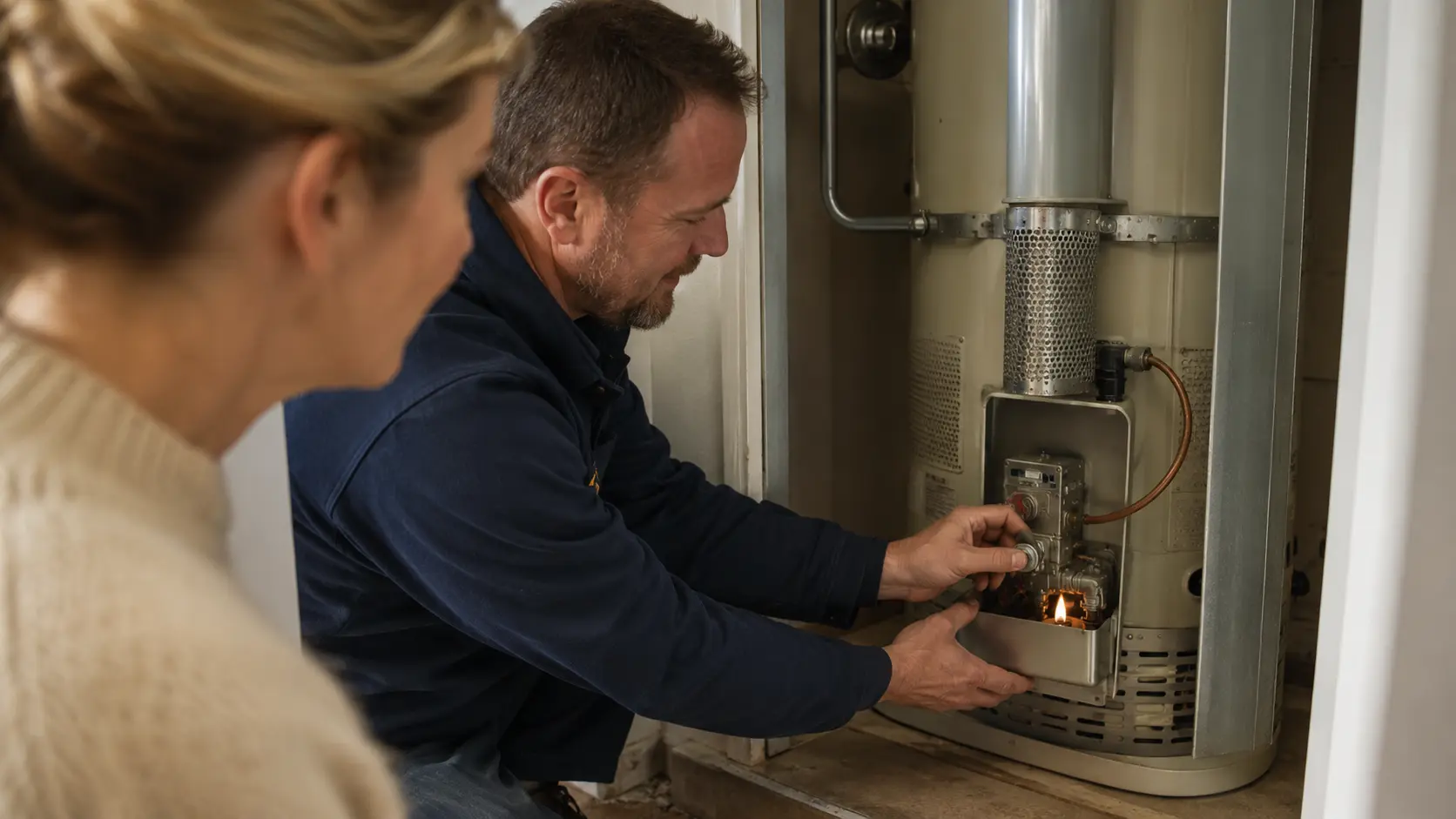
Storage gas systems use either a pilot light that burns continuously, or an electronic ignition that fires when the burner is needed. Most modern Rinnai storage units use electronic ignition, so there is no standing pilot flame to maintain. Older units from various brands typically have a pilot that needs to be lit manually.
To start up a gas storage system:
- Step 1: Confirm the cold water supply valve is open and the tank is full. Open a hot water tap briefly to check.
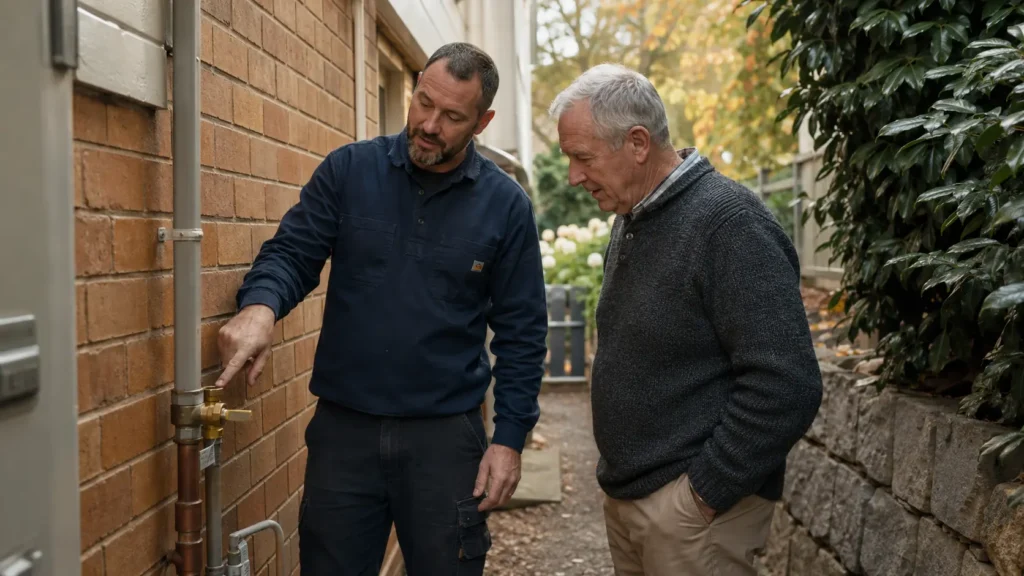
- Step 2: Locate the gas valve on the incoming gas line to the unit and turn it to the open (fully parallel) position.
- Step 3: Find the access cover on the front or base of the unit. The relight instructions are printed on the inside of this cover. Follow those instructions exactly, as they are model-specific.
- Step 4 (older units with pilot light): Turn the gas control knob to the “Pilot” position. Press and hold it in while using a long lighter to ignite the pilot flame. Hold the knob down for approximately 30 seconds after ignition to allow the thermocouple to heat up. Release and check the flame stays lit.
- Step 4 (modern units with electronic ignition): Set the gas control knob to the desired temperature setting. The burner will ignite automatically when the water temperature drops below the set point.
- Step 5: Allow 30 to 90 minutes for the tank to reach temperature before testing at a tap.
| Safety note: If you smell gas at any point, do not proceed. Turn the gas valve off, leave the area, and call a licensed gasfitter for your hot water system repair. Do not use light switches, phones, or anything electrical until you are well clear of the building. |
Instantaneous gas hot water system
Instantaneous gas systems have no tank and heat water only when a tap is opened. Modern units, including Rinnai’s continuous flow range, use electronic ignition with no standing pilot light. This means they use no gas at all when there is no hot water demand.
To start up an instantaneous gas system:
- Step 1: Confirm the gas supply valve on the incoming line is open.
- Step 2: Confirm the cold water inlet valve on the unit is open.
- Step 3: If the unit has a power connection (most modern units require a 240V supply or battery power for ignition), confirm the power is on.
- Step 4: Open a hot water tap. The unit will ignite automatically and begin heating. Hot water should arrive at the tap within a few seconds once the unit fires.
| Tip: If the unit clicks repeatedly but fails to ignite, check the battery in models that use battery ignition. A flat battery is a common cause of no-hot-water calls that don’t require a plumber. |
If replacing the battery doesn’t restore hot water, there may be another underlying issue. Learn about other common reasons your hot water is not working.
How to turn off a gas hot water system
For temporary shutdowns (overnight trips, short maintenance work):
- Storage: Turn the gas control knob to the “Pilot” or “Vacation” setting to keep the pilot lit but stop the main burner heating the tank.
- Instantaneous: No action needed. With no demand, the unit is already off.
For full shutdowns (extended absence, repairs, system replacement):
- Step 1: Turn the gas control knob or the main gas valve to the off position.
- Step 2: Close the cold water inlet valve on the unit.
- Step 3: If the unit has an electrical connection for ignition, switch it off at the power point or isolator.
How to Turn On an Electric Hot Water System
Electric storage systems are common across Australian homes. They use one or two heating elements inside the tank and are typically connected to a dedicated circuit in your switchboard, sometimes on an off-peak tariff to reduce running costs.
Starting up an electric storage system
The single most important rule with electric hot water: never turn on the circuit breaker until the tank is completely full of water. Heating elements that fire in a dry or partially filled tank will burn out, and this fault is excluded from most warranties.
Steps to start up:
- Step 1: Open the cold water inlet valve to the tank. This is usually located at the bottom or side of the unit.
- Step 2: Open a hot water tap inside the house and leave it running until a steady, uninterrupted stream of water flows out. This confirms the tank is full and all air has been purged from the line.
- Step 3: Close the tap.
- Step 4: Go to your main switchboard and find the circuit breaker or isolator labelled “Hot Water” or “HWS”. Switch it on.
- Step 5: Allow 30 to 90 minutes for a standard storage tank to heat up to temperature before testing.
How to turn off an electric hot water system
For routine maintenance, before working on plumbing near the system, or when the property will be vacant:
- Step 1: Locate the circuit breaker or isolator at your switchboard labelled “Hot Water” or “HWS” and switch it to the off position.
- Step 2: If you need to isolate the water supply, close the cold water inlet valve on the unit.
- Step 3: Open a hot water tap briefly to relieve pressure in the pipes before doing any work on the system.
If you’re just going on holiday for a few weeks, switching off the circuit breaker for an electric hot water system is a sensible way to save energy while you’re away.
If your system is becoming unreliable or requires frequent restarts, it may be nearing the end of its service life. Find out how long hot water systems last and the signs it’s time to replace one.
How to Turn On a Heat Pump Hot Water System
Heat pump hot water systems work by drawing heat from the surrounding air and transferring it to water in an insulated tank. They run on electricity but are significantly more efficient than conventional electric storage systems, typically producing three to four units of heat for every one unit of electricity consumed.
Common heat pump brands installed in the Southern Highlands and surrounding areas include Daikin, Rinnai, iStore, Reclaim Energy, Stiebel Eltron, and Apricus.
Starting up a heat pump system
The fill-before-energise rule applies here just as it does with electric storage systems. Do not power on a heat pump connected to an empty tank.
- Step 1: Open the cold water supply valve to the unit. This is typically located at the cold water inlet at the base of the storage tank.
- Step 2: Open a hot water tap and allow water to flow freely until there’s no more air sputtering from the line.
- Step 3: Close the tap.
- Step 4: Switch on the dedicated circuit breaker at the switchboard. The unit should power up and the controller or indicator light will confirm it’s active.
- Step 5: Allow two to four hours for the initial heat-up on a cold tank. Heat pumps operate more slowly than direct electric elements, particularly in cool weather.
Temperature settings and scheduling
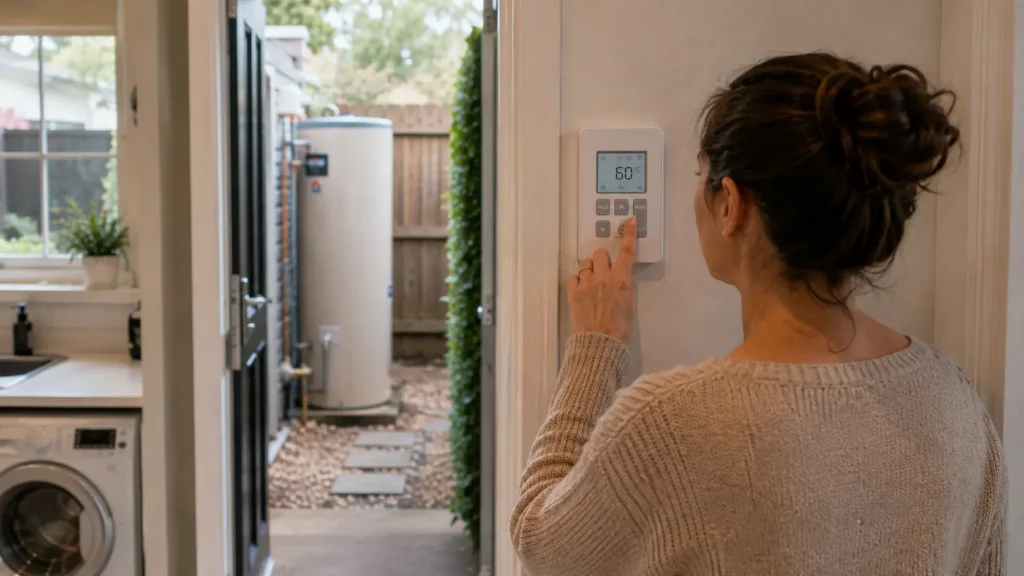
Heat pump controllers vary by brand. Most Daikin units, for example, allow you to set eco and comfort temperature targets and schedule heating for specific times of day. Running the heat pump during daylight hours when solar panels are producing, or during off-peak periods, reduces operating costs considerably.
A typical set point for stored hot water in Australian homes is 60°C. This temperature is recommended by health authorities to inhibit bacterial growth in the tank.
How to turn off a heat pump hot water system
For short absences or temporary shutdowns:
- Many units have a holiday or away mode accessible through the controller. This suspends normal heating while maintaining a minimum temperature or disinfection cycle. Check your unit’s manual for the specific setting.
For complete shutdown:
- Step 1: Switch off the circuit breaker at the switchboard.
- Step 2: Close the cold water inlet valve if you need to isolate the water supply.
- Step 3: Allow the unit to sit for at least 30 minutes before any inspection or service work, as heat pumps can hold pressure internally after shutdown.
Gas vs Electric vs Heat Pump: Key Differences at a Glance
| Feature | Gas (Storage) | Gas (Instantaneous) | Electric Storage | Heat Pump |
|---|---|---|---|---|
| Heat-up time | 30-90 min | Instant (on demand) | 30-90 min | 2-4 hours (initial) |
| Startup steps | Relight pilot/burner | Open gas valve | Fill tank, switch breaker | Fill tank, switch breaker |
| Energy when idle | Pilot light (older units) | None | Minimal (standby loss) | Minimal (standby loss) |
| Turn off method | Gas control knob + valve | Close gas valve | Circuit breaker | Circuit breaker |
| Most important safety step | Check for gas smell | Check for gas smell | Fill tank before power on | Fill tank before power on |
| Holiday shutdown option | Vacation/pilot mode | Gas valve off | Switch off breaker | Holiday mode on controller |
When to Call a Professional
Some situations call for a licensed plumber or gasfitter rather than a DIY restart. Contact a tradesperson if:
- You smell gas at or near the unit at any point
- The pilot light won’t stay lit after repeated attempts
- The circuit breaker trips every time you switch the system on
- Water is leaking from the tank, the pressure relief valve, or any connections
- The unit displays a fault code and the manual doesn’t resolve it
- The system has been off for an extended period and you’re not sure whether it was correctly decommissioned
- You’re unsure what type of system you have or can’t find the shut-off valves
Gas work of any kind, including relighting a pilot on some systems, must be carried out by a licensed gasfitter in Australia. If there is any doubt, don’t proceed. If the unit needs replacing rather than repairing, it’s worth understanding the cost of installing a hot water system in Australia before arranging the work.