
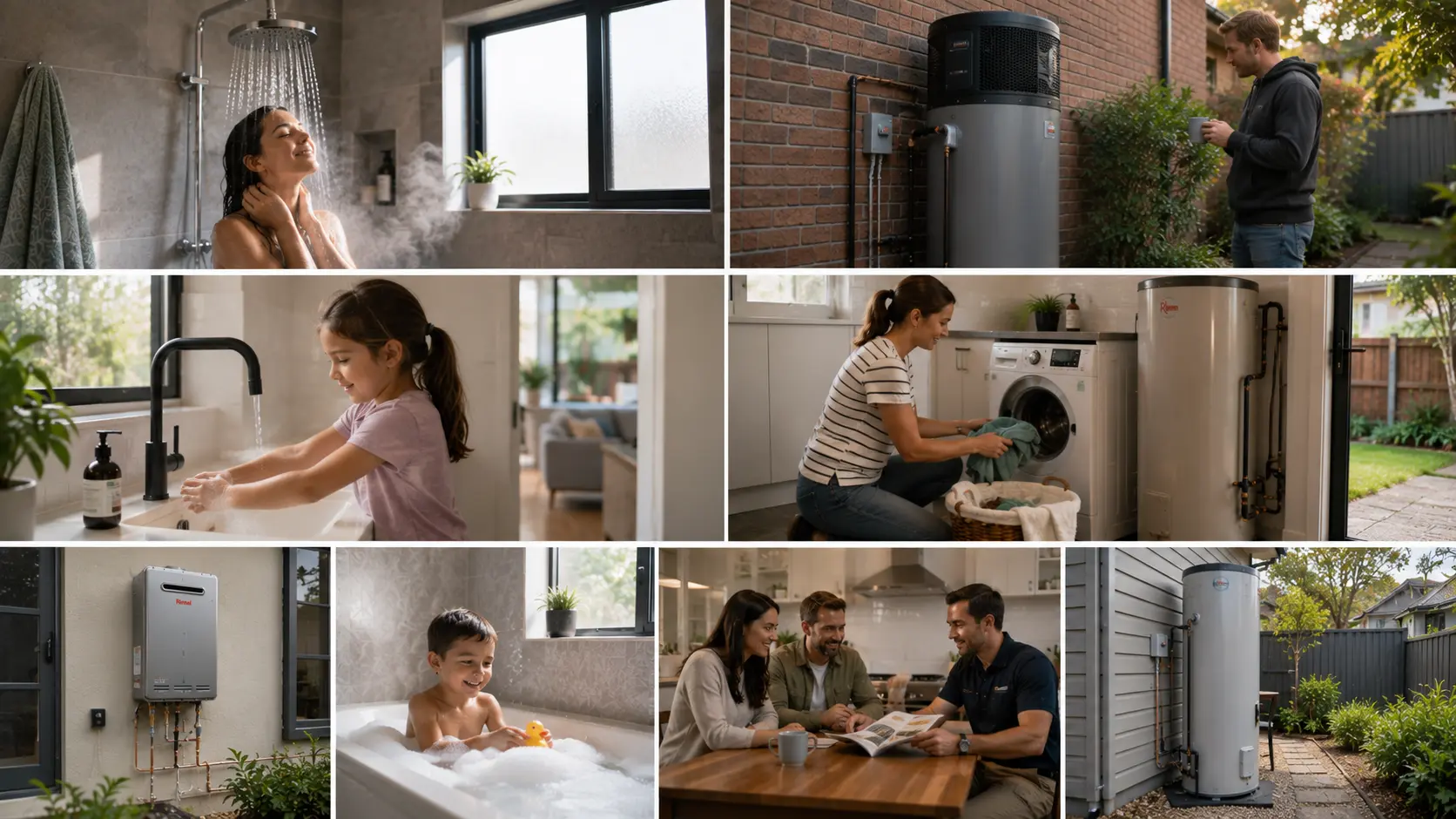
Choosing the right hot water system comes down to three things: how much hot water your household uses, how you’d prefer to pay for it, and what energy source suits your home. Get those right and you’ll have reliable, affordable hot water for the next decade or more.
This guide covers the main system types, how to size correctly, what installation involves, and how to spot a failing system before it leaves you in the cold.
| ⚡ Quick Answer |
| Hot water accounts for around 15 to 25 per cent of the average Australian household energy bill. A heat pump hot water system is the most energy-efficient option for most homes, especially those with solar panels. Gas continuous flow suits high-volume households that want on-demand delivery without a tank. Electric storage is the lowest upfront cost but the most expensive to run long term. |
Types of Hot Water Systems Available in Australia
Australian homes use four main hot water systems, each with a different approach to efficiency, cost, and delivery.
Heat Pump Hot Water Systems
A heat pump works like a refrigerator in reverse: instead of removing heat from inside a box, it pulls warmth from the surrounding air and transfers it into your storage tank. Because it moves existing heat rather than generating it, a heat pump produces roughly three to four units of heat for every unit of electricity consumed. That efficiency gap is why running costs are so much lower than conventional electric systems.
Heat pump systems come in two configurations: integrated (compressor, fan, and tank as one self-contained unit) and split (compressor separate from the tank, useful when space or placement is restricted).
Best suited to: homes with existing solar panels or households replacing an electric storage system where long-term running costs are the priority.
Gas Continuous Flow Systems
Continuous flow (also called instantaneous) gas systems heat water on demand with no storage tank involved. Cold water passes through the unit, a gas burner fires on demand, and hot water arrives at the tap. There’s no stored volume to run out of, which makes these systems particularly suited to high-demand households with back-to-back shower usage or multiple bathrooms running simultaneously.
Best suited to: large families or households with limited space.
If you’re weighing up heat pump versus gas for your next system, the cost and comfort differences in real-world use are covered in detail in our heat pump vs instantaneous gas guide.
Gas Storage Systems
Gas storage systems work like electric storage systems but use a gas burner instead of an element. They’re a natural like-for-like replacement for homes already connected to natural gas. Running costs sit noticeably lower than electric storage, though the tank loses some heat continuously regardless of demand.
Electric Storage Hot Water Systems
Electric storage uses a resistance element inside a tank to heat water, similar in principle to a kettle. Installation is the most straightforward of any system type, with typical fully installed costs around ~$800 to ~$1,800. The trade-off is running cost: electric resistance converts electricity to heat at a one-to-one ratio, making these systems consistently the most expensive to operate, with annual running costs reaching ~$1,000 to ~$1,300 on a standard tariff. An off-peak tariff reduces this but doesn’t close the efficiency gap with heat pump systems.
Best suited to: smaller households on tight upfront budgets or rental properties where the owner prioritises low entry cost.
Hot Water System Comparison at a Glance
| System Type | Upfront Cost (approx.) | Annual Running Cost (approx.) | Lifespan (approx.) | Best For |
| Electric Storage | ~$800 to ~$1,800 installed | ~$1,000 to ~$1,300 | ~8 to 12 years | Low entry cost, smaller households, off-peak tariff |
| Gas Storage | ~$1,200 to ~$2,500 installed | ~$600 to ~$800 | ~8 to 12 years | Existing gas connection, moderate demand |
| Gas Continuous Flow | ~$1,500 to ~$2,800 installed | ~$600 to ~$800 | ~15 to 20 years | High volume, multiple bathrooms, no tank preferred |
| Heat Pump | ~$2,500 to ~$4,500 installed | ~$300 to ~$500 | ~10 to 15 years | Long-term savings, solar PV homes, full electric setups |
Running cost estimates are drawn from Sustainability Victoria 2024 and 2025 data for typical Australian households. Actual costs vary with household size, tariff type, usage habits, and local climate. Government incentives may reduce the upfront cost of heat pump installations, ask us for current details when requesting a quote.
How to Size a Hot Water System for Your Household
Getting the size right matters as much as picking the right system type. Too small and you run out of hot water mid-morning; too large and you spend money heating water nobody uses.
The 50-Litre Rule
The standard benchmark across the Australian hot water industry is approximately 50 litres of hot water per person per day. For storage systems, sizing to cover one to one and a half days of usage gives enough buffer to handle peak demand without running short.
| Household Size | Estimated Daily Use | Recommended Storage Capacity |
| 1 to 2 people | ~50 to 100 litres | ~125 to 160 litres |
| 3 to 4 people | ~150 to 200 litres | ~200 to 250 litres |
| 5 to 6 people | ~250 to 300 litres | ~280 to 315 litres |
| 6+ people | ~300+ litres | ~315 to 400 litres |

What Shifts the Numbers
A few factors push your requirement above or below the baseline:
- Peak timing: If everyone showers in the same morning window, you need more buffer than the daily average suggests.
- Shower flow rate: Older high-flow showerheads consume significantly more hot water per minute. Water-efficient 3-star heads, rated at around 9 litres per minute, reduce daily demand noticeably.
- Continuous flow gas: Sized by flow rate in litres per minute, not tank volume. Match the rating to how many outlets run simultaneously.
- Climate: In cooler regions like the Southern Highlands, heat pump systems benefit from slightly more tank capacity to compensate for reduced efficiency on cold overnight air.
- Future household size: A hot water system installed today may serve your home for ten to fifteen years. Sizing for where your household is heading, not just where it is now, avoids a premature replacement.
For a full breakdown by family size and system type, including how heat pumps are sized differently from electric storage, see our hot water system sizing guide.
Why Heat Pump Hot Water Is Worth the Upfront Cost
Most households replacing an electric storage system will recoup the cost difference within roughly three to seven years through lower running costs alone, without accounting for any government incentives that may be available.
A few practical points to factor into your decision:
- Noise: Heat pump compressors produce a low operational hum, similar to a quiet air conditioner. Placement away from bedroom windows matters.
- Space: Integrated units need good ventilation around them. They’re typically installed outdoors or in a large, open utility area.
- Cold nights: Efficiency drops on very cold nights. Southern Highlands properties should specify a model with an electric booster element to cover those conditions without affecting comfort.
Hot Water System Installation: What to Expect
A like-for-like replacement in the same location is the most straightforward scenario. Switching system types, relocating the unit, or upgrading electrical infrastructure adds time and cost to any installation.
Typical Installed Costs
- Electric storage: ~$800 to ~$1,800 for a standard like-for-like replacement.
- Gas storage: ~$1,200 to ~$2,500, varying with system size and site access.
- Gas continuous flow: ~$1,500 to ~$2,800, with additional cost if gas line work is required.
- Heat pump: ~$2,500 to ~$4,500. Government incentives may apply and can reduce this meaningfully, ask us for current details when booking a quote.
What the Installation Involves
- Removal and disposal of the existing system.
- Pressure and temperature relief valve checks and replacement as needed.
- Connection to existing water supply and energy source.
- For heat pump systems: switchboard capacity check and dedicated circuit if required.
- All work completed by licensed tradespeople. In NSW, gas connections require a gas licence and hot water electrical work requires a restricted electrical licence.
For a full breakdown of what drives the final price across each system type, our hot water installation cost guide covers it in detail.
How Long Does a Hot Water System Last?
Knowing the expected lifespan of your system helps you plan for replacement before it fails unexpectedly.
- Electric storage: ~8 to 12 years. The heating element and tank lining are typically the first components to fail.
- Gas storage: ~8 to 12 years, similar to electric storage.
- Gas continuous flow: ~15 to 20 years with regular servicing. No storage tank means fewer corrosion risks over time.
- Heat pump: ~10 to 15 years. Proper placement, good airflow, and annual servicing are the biggest factors in reaching the upper end of that range.
For all storage systems, checking the sacrificial anode every three to five years is one of the most effective ways to extend lifespan. This internal component protects the tank from corrosion and is inexpensive to replace before it fails.
Our hot water system lifespan article covers the full picture including what factors accelerate wear and when repair stops making sense.
Signs Your Hot Water System May Be Failing
Most systems give warning signs well before they stop working. Catching them early is always cheaper than an emergency replacement.
- Inconsistent temperature: Fluctuating water temperature or reduced maximum heat typically points to a failing element, thermostat fault, or sediment scaling.
- Discoloured water: Rust-coloured or cloudy hot water indicates internal tank corrosion. Once a tank rusts through, replacement is the only option.
- Unusual noises: Popping or rumbling from a storage tank often signals sediment buildup at the base, forcing the system to work harder to heat water.
- Visible leaks: Water pooling around the base or moisture at fittings needs prompt attention. A leaking storage tank cannot be repaired.
- Rising energy bills: A system working harder than it should to maintain temperature will show on your bill before any obvious physical sign appears.
If your system is showing any of these, our guide on: signs of hot water system failure can help you assess whether you’re looking at a repair or a replacement.
When Your Hot Water Stops Working
Before calling for a service, a few quick checks can save time.
- No hot water at all: Check power supply for electric systems (circuit breaker) or gas supply and the pilot light for gas systems. If those are fine, the fault is likely an internal component failure.
- Running out faster than usual: Points to a failing element, a depleted anode, or a thermostat set too low. On older systems approaching ten years, it’s often a sign the system is nearing end of life.
For a deeper diagnosis, our why my hot water system is not working guide walks through the most common causes by system type.
How to Choose the Right Hot Water System for Your Home
Five questions that make the decision straightforward:
1. What energy source does your home have?
Homes on natural gas replacing like for like will find gas the path of least resistance. LPG running costs are significantly higher, which changes the maths. Full-electric homes, or households looking to phase out gas, are well-served by a heat pump system.
2. Do you have rooftop solar?
If yes, a heat pump should be at the top of your list. Timing the system to run during solar generation hours can reduce net hot water cost to near zero on most days.
3. Upfront cost or long-term cost?
Electric storage has the lowest entry price but loses significantly over a ten-year operating period. Heat pump costs more upfront but typically recovers the difference within three to seven years. Gas continuous flow sits between the two, with a reasonable upfront cost and lower running costs than electric storage.
4. What is your actual hot water demand?
High-volume households with teenagers, multiple bathrooms, or peak morning demand benefit from either a larger storage capacity or a continuous flow gas system. Couples and smaller households often find a mid-range heat pump covers their needs comfortably.
5. How long will you stay in the property?
The long-term running cost advantage of a heat pump makes strongest financial sense if you’re staying for ten or more years. For a shorter horizon, the upfront cost premium is harder to recover and gas or electric storage may suit bette
| Not sure which system suits your home? TempcoFRH Energy Solutions supplies, installs and services hot water systems across the Southern Highlands, Goulburn, and Southern Tablelands. Contact us and we’ll assess your home, your energy setup, and your usage, and recommend the right system without the sales pressure. |
Frequently Asked Questions
What is the most energy-efficient hot water system in Australia?
A heat pump hot water system. It produces three to four units of heat for every one unit of electricity consumed, compared to a one-to-one ratio for conventional electric storage. On a solar-equipped home, running costs can fall to near zero on most days.
Should I choose gas or electric hot water?
It depends on your existing energy setup and time horizon. If you’re on natural gas replacing like for like, gas is straightforward. If you have solar or are moving away from gas, a heat pump delivers the lowest long-term cost. Electric storage makes sense where upfront budget is the binding constraint.
How do I know what size system I need?
Start with 50 litres of storage capacity per person per day and size up by one tier to cover peak demand windows. A family of four typically lands in the 200 to 250 litre range for storage systems. Continuous flow gas systems are sized by flow rate in litres per minute, not volume.
Can I get a rebate on a new hot water system in NSW?
Government incentive schemes may be available for heat pump installations that can reduce upfront costs. Scheme eligibility and available discounts change over time, so ask us directly when you request a quote to get current information.
How do I know if my hot water system needs replacing?
Age is the first factor: storage systems over ten years old experiencing recurring issues are usually more cost-effective to replace than repair. Persistent temperature problems, discoloured water, leaks, or unexplained increases in energy bills are all signs worth acting on sooner rather than later.