
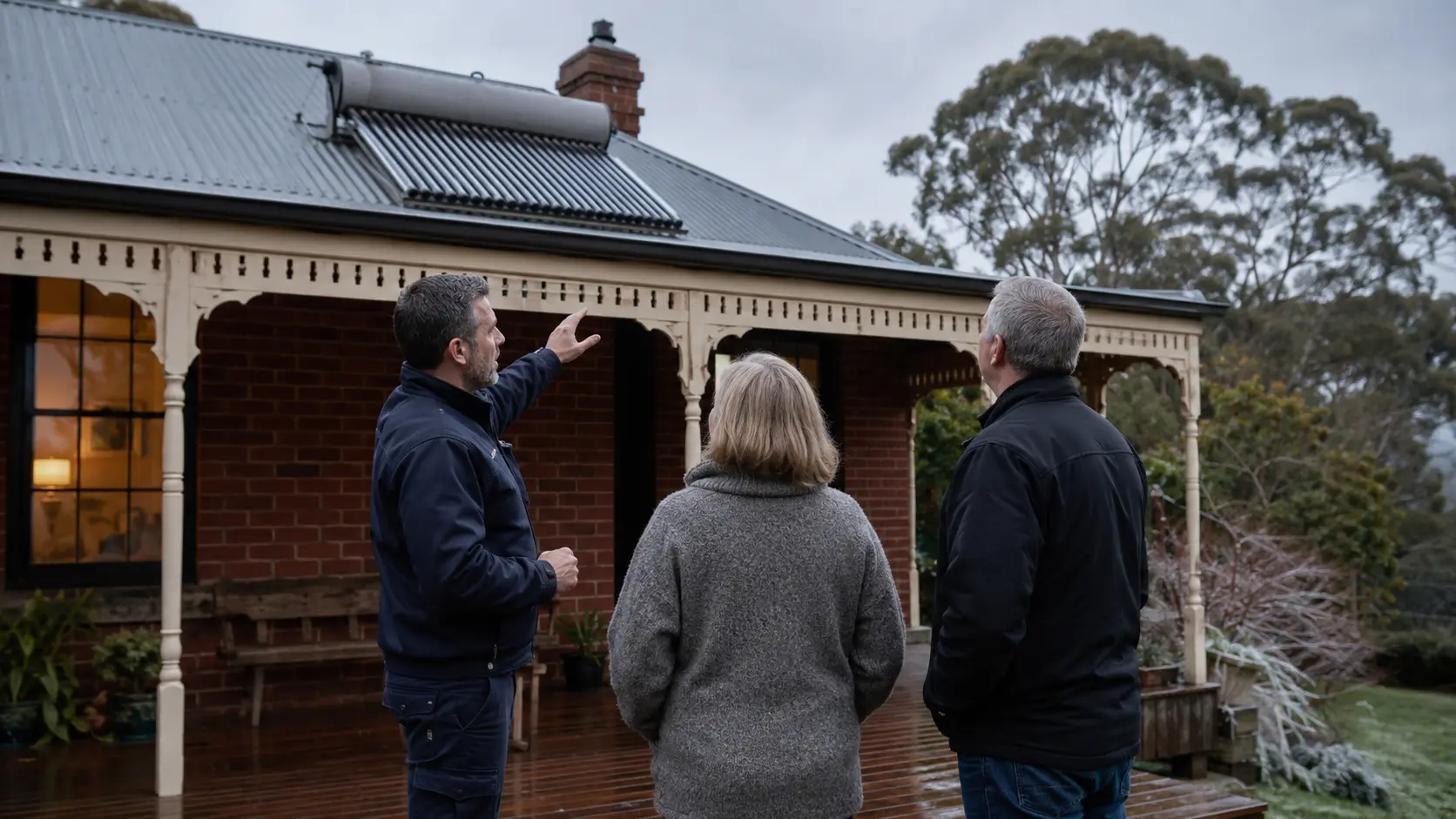
When your solar hot water system starts failing, you have four main replacement options: a heat pump hot water system, an instantaneous gas system, or a new system. Which one makes sense depends on your roof, your household, and how you use hot water.
The good news is that you do not have to replace it with the same type you had before. Technology has moved on, and in many cases there is a better fit for your home today. Below we walk through each option clearly, so you can make the right call.
How Do You Know It Is Time to Replace Your System?
A solar hot water system has two distinct parts that age at different rates. The rooftop collectors, whether flat plate or evacuated tube, can last ~20 years or more. The storage tank and booster are a different story. They typically need replacing somewhere in the ~10 to 15 year range, and once the tank starts leaking, there is no repairing it.
Keep an eye out for these signs:
- The tank is ~10 years old or older and showing rust, corrosion, or a leak at the base
- You are running out of hot water faster than you used to
- You hear banging or gurgling from the tank, a common sign of sediment build-up
- The booster element or thermostat has failed and a repair quote is approaching half the cost of a new system
- Your energy bills have crept up with no other obvious explanation
| QUICK ANSWER: If repair costs are approaching half the price of a new system, replacement is almost always the smarter financial decision. A leaking tank always means full replacement. It cannot be repaired. |
Your Hot Water System Replacement Options
Once you know a replacement is on the cards, here are the four main paths available to Southern Highlands homeowners.
Option 1: Switch to a Heat Pump Hot Water System
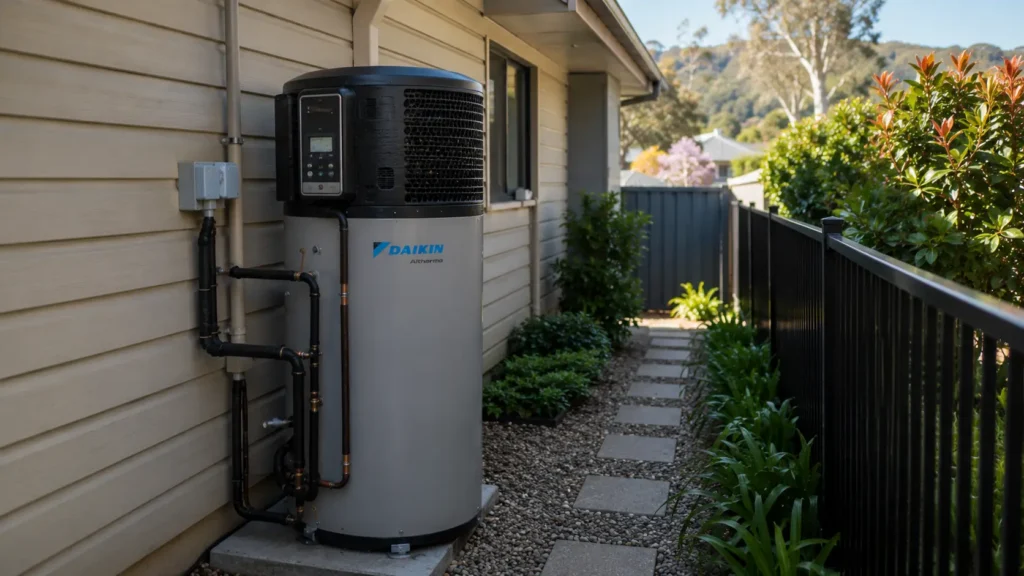
Heat pump hot water systems have become the most popular replacement choice across Australia in recent years, and for good reason. They do not rely on sunlight. Instead, they extract heat from the surrounding air and use it to warm water in a storage tank, much like a reverse-cycle air conditioner works in reverse.
A quality heat pump uses approximately 60 to 75% less electricity than a conventional electric hot water system. That makes them a strong, consistent performer even through a Southern Highlands winter, when solar collection drops away. The outdoor unit sits at ground level or on a wall bracket, so your roof is completely free.
What to consider:
- No roof access or collector maintenance required
- Works reliably in cold conditions, with quality units operating well below 0°C
- If you have rooftop solar PV, scheduling the heat pump to run during daylight hours can bring water heating costs close to zero
- Upfront costs generally range from approximately $3,000 to $5,000 installed after available incentives
- Annual running costs sit around $150 to $300 for a typical household, well below a conventional electric system
Option 2: Switch to Instantaneous Gas Hot Water
An instantaneous gas system, also called continuous flow, heats water on demand rather than storing it in a tank. There is nothing to hold or lose heat overnight, and the compact units last a long time, often around ~15 to 20 years.
Gas prices in NSW have risen steadily in recent years, which affects the long-term running cost picture. Still, for the right household, an instantaneous system remains a practical and cost-effective option.
What to consider:
- Works well for households with variable demand, since you only heat what you actually use
- No storage tank means no heat loss from water sitting idle overnight
- Longer lifespan than most storage systems, with fewer components to service
- Rising gas prices in NSW make long-term running costs harder to predict
- Less suited to households planning to move away from gas over the coming years
Weighing the heat pump against gas? Our detailed comparison, heat pump vs instantaneous gas hot water, walks through both options side by side.
Option 3: Replace Like-for-Like With a New Solar Hot Water System
If your existing rooftop collectors are still in reasonable condition, you may be able to reuse them and simply swap out the storage tank. Where the collectors are also worn out, the full system goes: panels, tank, and all pipework.
Most systems in NSW include an electric booster to cover low-sun periods, particularly through winter.
What to consider:
- You still need a north-facing roof section with minimal shading for reliable performance
- Upfront costs for a fully installed system run from approximately $5,000 to $8,000 depending on system type and roof complexity
- Running costs are very low when conditions are good, but a well-managed booster schedule really matters in this climate
| INSTALLER TIP: If your existing booster was doing heavy lifting through June and July, that is a sign your roof aspect or shading is limiting solar contribution. A like-for-like replacement will face the same constraint. |
Running Costs: How the Options Compare
Both solar hot water and heat pump systems reduce water heating costs significantly compared to a conventional electric system.
Solar hot water performance is tied directly to sunshine hours. In sunnier parts of Australia, a well-positioned system can cover 70 to 80% of a household’s hot water needs from the sun alone. Here in the Highlands, that contribution falls considerably from late autumn through to early spring, and the electric booster picks up the difference.
| New Solar Hot Water | Heat Pump Hot Water | Instantaneous Gas | |
|---|---|---|---|
| Typical installed cost (after incentives) | ~$4,000 to $8,000 | ~$3,000 to $5,000 | ~$1,500 to $3,500 |
| Annual running costs (typical household) | ~$50 to $150 (summer avg.), higher with winter boosting | ~$150 to $300 | Varies with gas price |
| Roof space required | Yes, north-facing collectors | No | No |
| Cold or cloudy weather performance | Lower, booster steps in | Consistent | Consistent |
| Compatible with rooftop solar PV | Not directly | Yes, schedule to run in daylight | No |
| System lifespan | Collectors ~20 years, tank ~10 to 15 years | ~10 to 15 years | ~15 to 20 years |
| Best fit | Good roof aspect, lower winter demand | Cold climate, solar PV pairing, or no roof space | Variable demand, existing gas connection |
Want a clearer picture of what installation will set you back? Our guide to hot water installation costs breaks it down by system type.
How to Choose the Right Replacement for Your Home
The right replacement is not one-size-fits-all. A few key factors about your property and household make a real difference to which option actually performs best for you.
Your Roof and Any Existing Solar PV
If you already have solar PV panels, or plan to install them, a heat pump is often the more flexible pairing. You can schedule it to run during peak solar generation hours, effectively storing your solar electricity as hot water at almost no cost.
On the other hand, if you have a strong north-facing roof with no shading and no plans for PV, a new solar hot water system can make a lot of sense, especially for smaller households with lower winter demand.
Your Winter Hot Water Demand
Households with consistent, higher demand through winter, such as larger families, people working from home, or homes with multiple bathrooms in regular use, will feel the limitations of solar hot water more acutely in the colder months. A heat pump and instantaneous gas system delivers the same output in July as it does in January.
Size of hot water system is also worth thinking about before you commit. Getting the capacity right matters as much as the technology.
Your Gas Connection and Longer-Term Plans
If you are coming off a gas-boosted solar system and want to simplify, moving to an all-electric heat pump removes one variable from your energy bills and positions your home better for long-term electrification. Conversely, if gas is already well-established in your home and you plan to keep it, an instantaneous system may still make strong financial sense depending on your household’s daily usage pattern.
Your Budget, Upfront and Long-Term
Upfront cost and total cost are two different things. A cheaper system with higher running costs or a shorter lifespan often costs more over a decade than a more considered investment upfront. Government incentive programs in NSW can also reduce the gap between options, so the headline price is not always the full picture.
| INSTALLER TIP: Rather than asking which system is cheapest to buy, ask: what will this cost over the next ten years, factoring in running costs, maintenance, and the next replacement? That question usually changes the answer. |
If you want a proper recommendation for your home, Tempco FRH Energy provides hot water system installation and repair services covering assessment, supply, and full installation across the Southern Highlands.
Frequently Asked Questions.
Can I switch from solar hot water to a heat pump?
Yes, and it is a very common upgrade path. The old collectors come off the roof, the storage tank is replaced, and the heat pump outdoor unit is installed at ground level.
Will a heat pump work through a Southern Highlands winter?
Yes. Quality heat pump units are designed to operate in sub-zero temperatures, well within the range the Southern Highlands sees. Efficiency reduces slightly in very cold weather, but the system continues to deliver reliably. We select cold-climate-suitable models for this region specifically.
Are there government incentives available in NSW?
Yes. Federal and NSW government incentive programs exist for energy-efficient hot water systems, and they can meaningfully reduce upfront costs. The available schemes and amounts change over time, so we can advise you on eligibility as part of the quoting process. Ask us for the current details when you call.
How long will a new hot water system last?
A heat pump typically lasts approximately 10 to 15 years. Solar hot water has a two-part answer: collectors can last approximately 20 years or more with maintenance, while the storage tank runs approximately 10 to 15 years. Instantaneous gas units generally have the longest lifespan, around approximately 15 to 20 years, with fewer serviceable components.
Do I need a licensed tradesperson for the replacement?
Yes. Any electrical work must be completed by a licensed electrician, and plumbing connections require a licensed plumber. We handle both as part of a standard installation, including any required notifications and compliance documentation.