



For most households, a professional air conditioner service once a year is the right call, but the honest answer depends on how much you use the system and what conditions it runs in. A split system in a lightly-used holiday home is very different from a ducted reverse-cycle unit running through a Southern Highlands winter and a hot Bowral summer. Use this guide to work out the right service schedule for your situation, understand the signs that your system needs attention sooner, and know exactly what a professional service covers.
Air Conditioner Service Schedule: How Often Is Often Enough?
Most air conditioning manufacturers recommend a professional service every 1-2 years. In practice, the closer to annually you can manage it, the better: annual servicing catches developing issues before they become costly repairs and keeps efficiency where it should be.
Here’s how to think about your own schedule:
- Light use (one season or occasional): a professional service every two years is generally sufficient.
- Regular use (daily through summer or reverse cycle year-round): annual servicing is strongly recommended.
- Heavy use (all-day, all-year, large ducted system): consider servicing every six months if you run it intensively.
- Harsh environments (coastal salt air, heavy dust, or near livestock): more frequent servicing protects components from accelerated wear.
The Southern Highlands has its own demands. Cold Bowral winters push reverse-cycle systems hard in heating mode from June through August, then summer cooling season kicks in from December. Running a system year-round like that makes annual servicing the sensible baseline, not a luxury.
Filter cleaning is separate from a professional service. Filters should be checked and cleaned every 4-6 weeks during peak use. This is something you can do yourself: it takes five minutes and makes a noticeable difference to airflow and energy efficiency.
For a full explanation of how these systems work, see our guide to what is reverse cycle air conditioning.
Quick-reference service schedule by system type:
| System Type | Recommended Frequency | Heavy Use / Dusty Areas | DIY Between Services |
|---|---|---|---|
| Split system (single room) | Every 1-2 years | Annually | Wash filters every 4-6 weeks |
| Ducted reverse cycle | Annually | Every 6 months | Clean return air grilles regularly |
| Multi-room split system | Annually | Annually | Wash filters on each indoor unit |
How Often Should a Split System Air Conditioner Be Serviced?
A split system air conditioner typically needs a professional service every 1-2 years. Because it’s cooling or heating one room rather than a whole house, the workload per unit is lower than ducted, but that doesn’t mean it looks after itself.
Between professional services, clean the filters on your indoor unit every 4-6 weeks during periods of heavy use. Skipping this step forces the fan to work harder, which shows up on your power bill.
Watch the outdoor unit too. Trim back any plants, shrubs or debris that restrict airflow around the condenser. A blocked outdoor unit runs hotter and less efficiently, and the compressor takes the punishment.
Browse our range of air conditioner installation services if you are considering an upgrade, repair, or replacement.
How Often Should Ducted Air Conditioning Be Serviced?
Ducted reverse-cycle systems cover the whole home and have significantly more components to maintain. Annual servicing is the standard recommendation for most households, and for systems running year-round in the Highlands, that’s not conservative advice, it’s practical.
A ducted service covers more ground than a split system service. The technician inspects the fan coil unit, checks the refrigerant, cleans the coil and return air grille, checks all zone controls and motors, and inspects accessible ductwork for damage or leaks. Duct leaks alone can waste 20-30% of conditioned air before it reaches the rooms you want to heat or cool.
Between professional services, keep the return air grilles clear of dust buildup and furniture. Restricted return airflow puts unnecessary strain on the fan motor and reduces the system’s ability to reach set temperature, which means longer run times and higher running costs.
Signs Your Air Conditioner Needs Servicing Now
Don’t wait for your scheduled service if you notice any of these. Some indicate a simple maintenance issue; others point to developing faults that get more expensive the longer they run.
Blowing warm air in cooling mode. The most obvious sign something is wrong. Most likely causes are low refrigerant or a dirty evaporator coil that can’t transfer heat properly. Neither resolves itself, so book a service.
Power bills climbing without explanation. A dirty coil or blocked filter forces the compressor to work harder for the same output. You’re paying more for worse performance. Check your filters first; if they’re clean and bills are still up, book a service.
Musty or stale smell when running. Usually mould or bacteria growth on the evaporator coil or in the drip tray. This isn’t just unpleasant: it actively degrades indoor air quality and can aggravate respiratory issues. Book a service as soon as possible.
Weak or reduced airflow. Check the filters first. If they’re clean and airflow is still poor, there may be a blocked coil, a failing fan motor, or a duct issue on a ducted system. A technician can identify which within the first inspection.
Rattling, grinding or squealing noises. These usually indicate a loose component, failing bearing, or fan blade issue. Unusual mechanical sounds tend to get worse with time, not better. Book a service before a cheap fix becomes an expensive one.
Water dripping from the indoor unit. A small amount of condensation is normal, but water dripping inside is typically a blocked condensate drain line. Left unchecked it can cause water damage to walls and ceilings.
Frequent cycling on and off. If the system keeps switching itself on and off in short cycles, it’s likely short-cycling, a symptom of refrigerant issues, a dirty coil, or an electrical fault. It’s hard on the compressor and should be investigated.
Warning sign summary:
| Warning Sign | What It Usually Means | Action |
|---|---|---|
| Blowing warm air in cooling mode | Low refrigerant or dirty coil | Book a service |
| Higher than usual power bills | Dirty filters or coil reducing efficiency | Service or check filters |
| Musty or stale smell | Mould or bacteria on the evaporator | Book a service immediately |
| Weak or reduced airflow | Blocked filters or duct issue | Check filters; book if no improvement |
| Strange noises (rattling, grinding) | Fan or compressor issue | Book a service immediately |
| Water leaking from indoor unit | Blocked condensate drain | Book a service |
| Cycling on and off frequently | Thermostat fault or refrigerant issue | Book a service |
What Does a Professional Air Conditioning Service Actually Include?
A proper service is more than a quick clean. Here’s what a qualified technician should be doing during a standard service:
- Inspecting and cleaning the indoor evaporator coil
- Removing, cleaning, and refitting all filters
- Clearing the condensate drain line
- Checking refrigerant pressure (low refrigerant means the system is either leaking or was incorrectly charged)
- Testing electrical connections and contactors
- Inspecting and cleaning the outdoor condenser coil
- Checking fan motor operation on both indoor and outdoor units
- Testing thermostat calibration and control response
- On ducted systems: checking zone controls and inspecting accessible ductwork
After the service, the technician should give you a clear summary of what was done, any issues found, and what to watch for before the next service. If they can’t tell you what they did, that’s worth noting. See our airconditioning services page for what is included in a TempcoFRH service.
What Happens When You Skip Air Conditioner Servicing?
Skipping one service rarely causes an immediate problem. Skipping servicing over several years almost always does. Here’s what builds up when a system goes without professional maintenance:
Efficiency drops. Dirty coils and blocked filters reduce heat transfer efficiency. The compressor runs longer to reach the same temperature, which shows up directly on your energy bills.
Air quality suffers. Mould and bacteria accumulate on the evaporator coil and in the drip tray, then get pushed into your living space every time the system runs. This is a particular concern in ducted systems, where the same air circulates throughout the whole home.
Small faults become expensive repairs. Low refrigerant causes the compressor to overheat. A loose electrical contact causes arcing. A blocked drain causes water damage. Each of these starts as a minor issue that a service would catch early and ends as a major repair if left alone.
System lifespan shortens. A well-maintained air conditioning system typically lasts 15-20 years. A neglected one often needs replacing at 8-10 years. The cost difference between annual servicing and early replacement is significant.
Air Conditioner Maintenance You Can Do Yourself
You don’t need a technician for basic upkeep between services. These tasks are straightforward and genuinely make a difference:
Clean the Filters Regularly
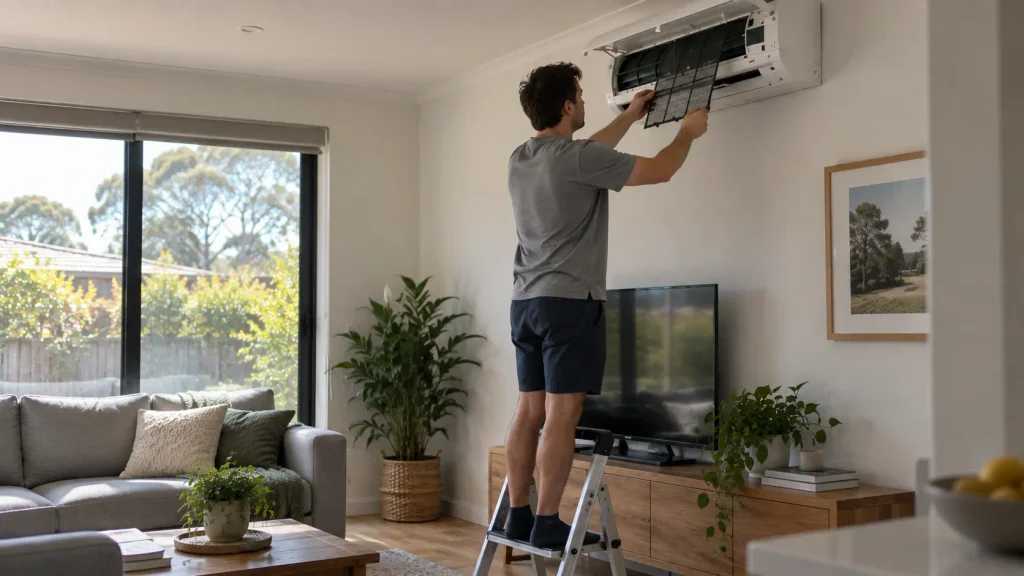
This is the single most effective thing you can do between services. Most split system filters slide out from the indoor unit, rinse clean under a tap (no detergent needed), and should be completely dry before going back in. During heavy use periods, including summer cooling and winter heating, check them every 4-6 weeks.
Keep the Outdoor Unit Clear
Trim back plants, remove leaves and debris, and make sure there’s at least 50cm of clear space around the condenser unit on all sides. In autumn, leaf litter and seeds can accumulate quickly, worth checking every few weeks.
Check the Condensate Drain
When running in cooling mode, your system produces condensation that drains outside. If you notice the indoor unit dripping or water pooling near it, the drain line may be blocked. This is usually a simple job for a technician but can cause water damage if left for long.
Run the System Before Peak Season
Turn your system on in mid-spring (September/October) to test it before summer cooling demand peaks. If it’s not performing as expected, you have time to book a service without the pressure of a heatwave already underway.
If your system is ageing, it may also be worth reviewing our guide to aircon installation cost to compare the cost of a service against a replacement.
Frequently Asked Questions
How often should I service my air conditioner in Australia?
Most Australian households should have their air conditioner professionally serviced once a year. If the system runs lightly or only in one season, every two years may be sufficient. Systems used heavily year-round or in dusty, coastal, or high-use environments benefit from annual or more frequent servicing.
Can I service my own air conditioner?
You can clean the filters, clear debris from around the outdoor unit, and check the condensate drain, and you should do these regularly. Refrigerant handling, coil cleaning, electrical checks, and duct inspection require a qualified air conditioning technician. Attempting refrigerant work without a licence is illegal in Australia.
How do I know if my air conditioner needs servicing?
The clearest signs are: blowing warm air in cooling mode, a musty smell when running, higher power bills without explanation, weak airflow, unusual noises, water dripping from the indoor unit, or the system cycling on and off frequently. Any of these warrants a service sooner than scheduled.
Does servicing my air conditioner reduce my power bills?
Yes, in most cases. A dirty coil and blocked filters reduce heat transfer efficiency, forcing the compressor to run longer for the same result. A clean, well-maintained system runs more efficiently and reaches set temperature faster, which typically translates to lower energy bills over the cooling and heating season.
How long does an air conditioning service take?
A standard split system service typically takes 45-90 minutes. A ducted system service is more involved and usually takes 1.5-3 hours depending on the size of the system and number of zones. Your technician should give you a clear timeframe when booking.
When is the best time to book an air conditioner service?
Spring (September to November) is the best time to book. Systems are serviced and tested before the summer cooling season, and availability is better than in December and January when demand peaks. For heating-focused reverse-cycle systems, late summer (February to March) works well before winter.
Does TempcoFRH service air conditioners it didn’t install?
Yes. Our service team works across all major brands, including Daikin, Rinnai, General (Fujitsu), and Mitsubishi Heavy Industries, regardless of who originally installed the system. Call us on 02 4862 5595 to book a service across the Southern Highlands.