


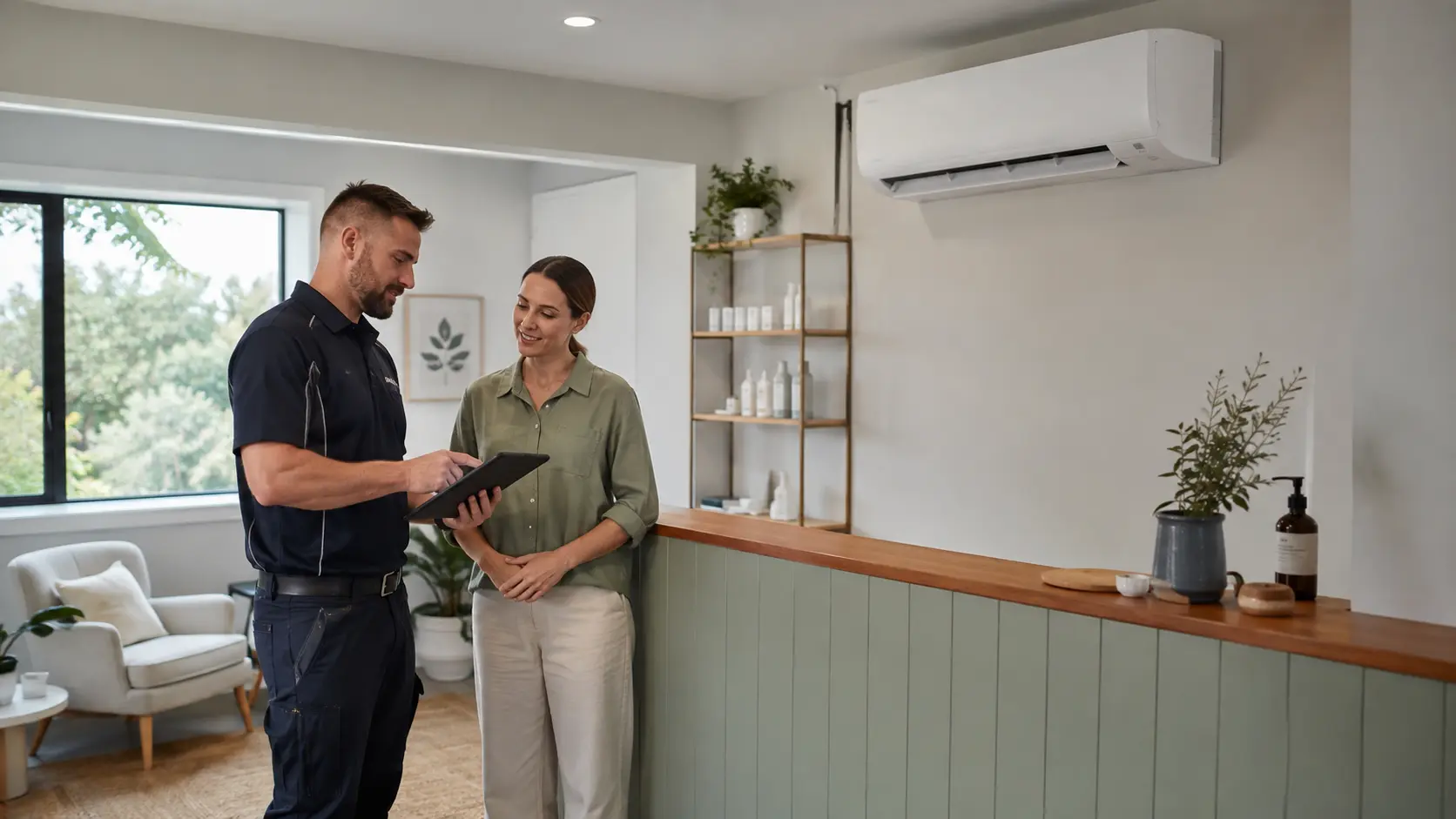
If you are planning to upgrade your heating and cooling this year, a government air conditioner rebate could reduce what you pay upfront on a new reverse cycle split system. In 2026, eligible Australian households and small businesses can access incentives through state-based energy upgrade programs, with the savings applied directly to your installation quote rather than as a later bank transfer.
This guide covers how the rebates work, who is eligible, which systems qualify, and what the application process actually looks like. We will also explain what to watch for so you do not miss out on savings you are entitled to.
How Split System Air Conditioner Rebates Work in Australia
The term “rebate” is commonly used, but these incentives technically work as upfront discounts rather than cashback payments. Here is the process in plain language:
- Your installer is an accredited provider under the relevant state scheme.
- When they install an eligible, energy-efficient reverse cycle air conditioner, the scheme calculates how much energy the new system will save over its lifetime.
- Those projected savings are converted into tradeable energy certificates.
- The value of those certificates is applied as a discount on your installation quote, so you pay less on the day.
- Your installer handles the certificate paperwork. You sign a nomination form and that is largely it for your end.
The practical result is that the price you see from an accredited installer already has the incentive built in. There is no reimbursement process, no government portal to navigate, and no waiting period. To understand the full cost picture before you commit, see our guide to aircon installation cost.
NSW: The Energy Savings Scheme (ESS)
In New South Wales, the relevant program is the Energy Savings Scheme (ESS), administered under the NSW Government’s Household Energy Saving Upgrades pathway. The scheme is legislated to run until 2050, so it is not a short-term initiative.
Who is eligible in NSW?
- Owner-occupiers of residential properties across NSW (metro and regional).
- Landlords can also access the scheme under specific pathways, making upgrades to rental properties more achievable.
- Small businesses in NSW are eligible through the same scheme.
There is no income test for the standard ESS discount on air conditioning upgrades.
What systems qualify?
To be eligible for an ESS discount, your new system must:
- Be a reverse cycle air conditioner (providing both heating and cooling).
- Be listed on the GEMS (Greenhouse and Energy Minimum Standards) Register.
- Meet the minimum energy efficiency requirements specified by the scheme.
- Be supplied and installed by an accredited ESS provider.
Most modern split systems from reputable manufacturers meet these requirements. High-star-rated models generally attract a higher discount because the energy saving they deliver is greater.
How much can you save in NSW?
The discount varies based on system capacity, efficiency rating, installation location, and whether you are replacing an existing unit or installing fresh. As a guide, indicative figures from the NSW Government show:
- Installing a new 6kW system: upfront discount available (indicative figure, actual amount varies).
- Replacing an old air conditioner with a 6kW split system: a higher indicative discount applies when an inefficient unit is being decommissioned.
We recommend asking your accredited installer for the exact figure for your specific system and site, as the discount reflects the actual energy certificates generated by your installation.
Victoria: The Victorian Energy Upgrades (VEU) Program
Victorian households and small businesses access government-backed discounts through the Victorian Energy Upgrades (VEU) program, administered by the Essential Services Commission of Victoria. Like the NSW scheme, the VEU operates through Victorian Energy Efficiency Certificates (VEECs), with the discount applied upfront at the point of installation.
Who is eligible under the VEU?
- Homeowners, renters (with landlord consent), and landlords in Victoria.
- Small businesses operating in Victoria.
- The scheme covers all Victorian postcodes, metropolitan and regional alike.
What systems qualify in Victoria?
- Reverse cycle air conditioners only, capable of both heating and cooling.
- The unit must be listed on the VEU Product Register (Essential Services Commission register).
- Must comply with GEMS Determination 2019 standards.
- Refrigerant GWP (Global Warming Potential) must be below 700. Most modern systems meet this requirement.
- Minimum five-year manufacturer warranty is required.
Minimum co-payments in Victoria
Unlike in NSW, the VEU program specifies a minimum amount you must contribute to your installation:
- Non-ducted split systems under 10kW: $200 minimum co-payment (GST inclusive).
- Non-ducted systems over 10kW and multi-head or ducted systems: $1,000 minimum co-payment (GST inclusive).
These are the minimum amounts you pay, not the total cost. Your accredited installer will give you a complete quote showing the discount applied.
| Installer Tip: VEU program rules are updated periodically by the Essential Services Commission. If you are reading this after mid-2026, confirm the current co-payment requirements with an accredited Victorian installer before proceeding. |
Rebate Eligibility Criteria at a Glance
| Criteria | NSW (ESS) | Victoria (VEU) |
|---|---|---|
| Who can apply | Owner-occupiers, landlords, small businesses | Owner-occupiers, renters (w/ consent), landlords, small businesses |
| System type | Reverse cycle (split or ducted) | Reverse cycle (split or ducted) |
| Efficiency requirement | GEMS Register listed; high star rating preferred | GEMS listed; VEU Product Register listed |
| Income test | None for standard AC upgrade | None |
| Installer requirement | Accredited Certificate Provider (ACP) | VEU Accredited Provider |
| Minimum co-payment | No mandated minimum | $200 (small splits) or $1,000 (larger/ducted) |
| How discount is applied | Upfront on installation quote | Upfront on installation quote |
Which Air Conditioning Systems Are Eligible for Rebates?
The key requirement across both NSW and Victorian programs is that your new system must be a reverse cycle air conditioner. This means it can both heat and cool your home using electricity, rather than relying on gas or resistive electric heating.
Eligible system types
Reverse cycle split systems: The most common residential option. A single indoor wall unit paired with an outdoor compressor, covering one room or open-plan zone. For a full explanation of how these systems work, see our guide to what is reverse cycle air conditioning.
Multi-head split systems: One outdoor unit serving multiple indoor heads across different rooms. Suitable for whole-home coverage without ductwork.
Ducted reverse cycle systems: Central systems that distribute conditioned air through ceiling ducts. Often attract larger rebates, particularly when replacing a ducted gas heater.
Systems that do not qualify
- Heating-only or cooling-only systems. The reverse cycle (heat pump) function must be present.
- Window units and portable air conditioners.
- Gas-only ducted heating systems (though replacing one with a reverse cycle system is strongly incentivised).
If you are replacing an old ducted gas heater or an inefficient window air conditioner, both schemes treat this as a priority upgrade and may offer a higher incentive than a straightforward new installation. Browse our range of air conditioner installation services in the Southern Highlands to compare eligible reverse cycle models.
How to Apply for a Split System Air Conditioner Rebate
The application process is largely handled by your accredited installer. Here is what the typical process looks like:
- Step 1: Choose an accredited installer. Only accredited providers can generate the energy certificates that create your discount. Confirm accreditation before requesting a quote.
- Step 2: Site assessment. Your installer visits to assess your property, confirms eligibility, and recommends the right-sized system for your space.
- Step 3: Review your quote. The quote should clearly show the full system price, the discount applied under the relevant scheme, and what you pay. Ask if it does not show this.
- Step 4: Sign the nomination form. This is typically a one-page document confirming you are nominating the installer as your accredited provider. It is required before installation begins.
- Step 5: Installation. Your new system is installed. You pay the discounted amount shown in your quote. The installer handles the certificate claim separately.
There are no online rebate portals for you to navigate, no forms to mail off, and no waiting for a bank transfer. The saving is built into what you pay on installation day.

Choosing the Right System to Maximise Your Rebate
Not all split systems attract the same discount. Higher efficiency ratings generate more energy certificates, which translates into a larger upfront saving for you. That said, choosing the right system for your home goes beyond chasing the biggest rebate.
Capacity sizing
An undersized system will run constantly and never reach your comfort setpoint, while an oversized one will short-cycle and wear out faster. Your installer should do a proper load calculation based on your room size, ceiling height, insulation, and local climate before recommending a capacity.
Our guide on what size aircon do I need covers the key variables in detail.
Star rating
The energy star label on an air conditioner rates efficiency separately for cooling and heating. In a climate like the Southern Highlands, where you need both across the year, look at both ratings. Systems with six or more stars are typically well-positioned for rebate eligibility and will return the most in ongoing energy savings.
Inverter technology
All modern energy-efficient split systems use inverter compressors, which adjust output to match demand rather than cycling on and off at full power. This is what makes them far more efficient than older fixed-speed units. Confirm your chosen model uses inverter technology.
Replacing versus new installation
Both state schemes offer incentives for new installations, but the largest discounts often apply when you are replacing an old or inefficient heating and cooling system. If you currently have an old gas ducted heater or an ageing single-speed air conditioner, upgrading to a modern reverse cycle system may attract a substantially higher discount than a new installation with nothing to replace.
Once your new system is installed, our guide on how often to service your aircon will help you keep it running efficiently.
Upgrade Your Heating and Cooling in the Southern Highlands
At TempcoFRH, we supply and install energy-efficient reverse cycle split systems across Bowral, Mittagong, Moss Vale, and throughout the Southern Highlands. We work with Daikin, Rinnai, and General (Fujitsu) split systems across a range of capacities, so we can recommend the right match for your home and budget.
If you are considering an upgrade this year, we are happy to walk you through the options, explain what incentives may be available for your specific situation, and provide a clear quote that reflects any applicable government discount.
Learn more about our airconditioning services and what is included at each stage.
Frequently Asked Questions
Is there a government rebate for split system air conditioners in Australia in 2026?
Yes, state-based government incentives are available for eligible reverse cycle split systems in NSW and Victoria. The incentives are applied as upfront discounts on your installation quote through an accredited installer. The amount depends on your system’s capacity, efficiency rating, and what (if anything) you are replacing.
Do I need to fill in forms to claim the rebate?
You sign a short nomination form confirming your accredited installer before the installation goes ahead. Beyond that, your installer handles the certificate claim. There is no separate rebate application for you to submit.
Can renters access split system rebates?
In Victoria, yes, renters can access the VEU program with their landlord’s consent. In NSW, the standard ESS pathway is primarily for owner-occupiers, though landlords have their own eligible pathway they can access.
Does the rebate cover ducted air conditioning as well as split systems?
Both the NSW ESS and the Victorian VEU program cover ducted reverse cycle systems, not just split systems. Ducted upgrades, particularly when replacing an old gas ducted heater, often attract the largest available discounts under both programs.
Can a small business claim an air conditioning rebate?
Yes. Both the NSW ESS and the Victorian VEU program extend to small businesses, not just residential properties. Your installer will confirm eligibility for your specific premises and system during the assessment.
Does my old system need to be decommissioned?
If you are replacing an existing system, yes, the old unit is typically decommissioned as part of the upgrade. This is actually one of the conditions that can increase the rebate amount, as the scheme credits the removal of an inefficient system. Your accredited installer manages decommissioning as part of the job.
How do I know which split systems qualify for the rebate?
Eligible systems are listed on the GEMS Register (nationally) and, for Victoria specifically, the VEU Product Register maintained by the Essential Services Commission. In practice, most modern reverse cycle systems from established manufacturers qualify. Your accredited installer can confirm whether your preferred model is eligible before you commit to a purchase.