
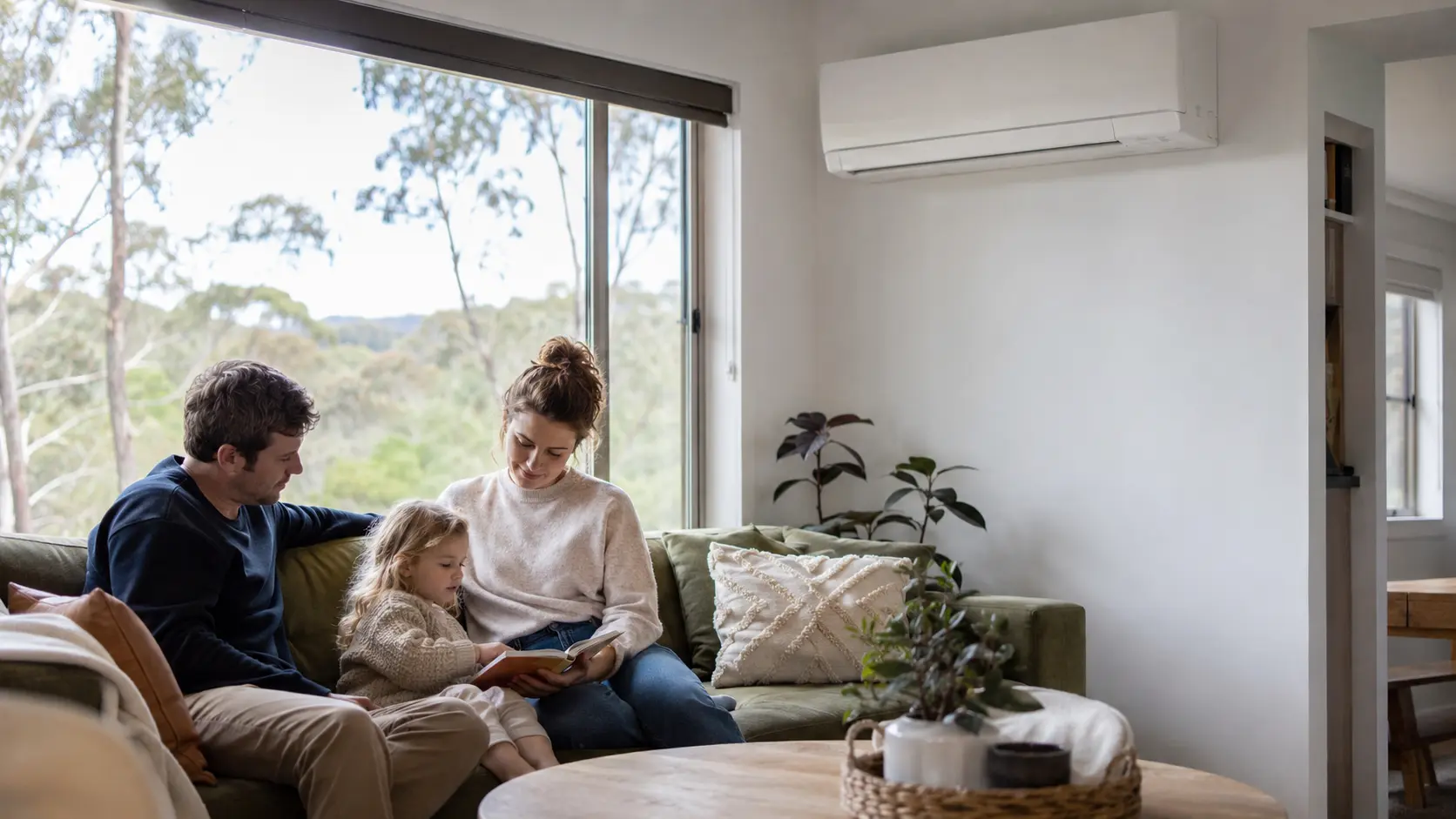
A reverse cycle air conditioner heats in winter and cools in summer from one system. It does this by moving heat rather than generating it, which is why it uses far less electricity than a bar heater or gas heater for the same level of warmth.
If you are weighing up your heating and cooling options in the Southern Highlands, or trying to understand what is already in your home, this guide covers how the technology works, how to read the energy label and signs that your reverse cycle system may need replacement.
How a Reverse Cycle Air Conditioner Works
The system runs on a refrigerant loop between an indoor unit and an outdoor unit. Refrigerant is a fluid that absorbs and releases heat very efficiently as it changes between liquid and gas states.
In cooling mode, the indoor unit draws warm room air across a cold coil. The refrigerant absorbs that heat, evaporates into a gas, and carries it to the outdoor unit, where the compressor releases it outside. Your room air comes back cooler.
In heating mode, the four-way reversing valve flips the direction of refrigerant flow. Now the outdoor unit absorbs heat from outside air, the compressor concentrates it, and the indoor unit releases it into your room. Outside air at 2°C still contains enough heat energy for this process to work effectively.
Inverter technology varies the compressor speed continuously rather than switching on and off at full power. This keeps temperatures steadier, reduces energy spikes, and makes operation quieter at both the indoor and outdoor unit.
If you want to know more on how daikin models perform in practice, see our Daikin air conditioning guide.
Why Reverse Cycle Is More Efficient Than Gas or Electric Resistance Heating
The efficiency of a heating system is measured by how much useful warmth it delivers per unit of energy consumed. This is called the Coefficient of Performance (COP).
| Heating type | COP (approx.) | What that means |
|---|---|---|
| Electric bar heater | 1.0 | $1 of electricity = $1 of warmth |
| Gas ducted heater | ~0.85 to 0.95 | Loses heat through flue and combustion |
| Reverse cycle (inverter) | ~3.0 to 5.0 | $1 of electricity = $3 to $5 of warmth |
A reverse cycle system does not generate heat; it moves it. Moving heat from outside to inside requires far less energy than creating heat from scratch. Even as gas tariffs and electricity prices shift, the efficiency gap in favour of reverse cycle remains significant for most households.
For a Southern Highlands home replacing ducted gas heating, this translates to meaningfully lower running costs over the life of the system, particularly as gas prices continue to rise. It is also worth reviewing the current split system rebates for 2026, which can reduce the upfront cost of switching.
Split System or Ducted Air Conditioning: Which Suits Your Home?
Both are reverse cycle systems. The difference is scale and delivery.
Split System Air Conditioners
A wall-mounted indoor unit and a compact outdoor unit condition one room or zone at a time. Upfront cost is lower, installation is quicker, and you only run the system where you need it. Split systems work well for bedrooms, living areas, or homes where a few targeted zones cover most of your daily use.
Browse our range of air conditioners to see available split system models and capacities.
Ducted Reverse Cycle Air Conditioning
A central indoor unit in the ceiling cavity pushes conditioned air through ducts to vents throughout the home. One outdoor unit, one controller, consistent temperatures room to room. Modern ducted systems include zoning, so you can turn off unused areas rather than conditioning the whole house at once.
For larger Highlands homes, or anyone replacing a ducted gas heater, a reverse cycle ducted system is usually the most practical path to whole-home comfort. It uses the existing ceiling space and delivers heating and cooling from a single installation.
See our airconditioning services for what is included in a full ducted installation.
| Split System | Ducted System | |
|---|---|---|
| Best for | 1 to 3 rooms | Whole home, 4+ rooms |
| Upfront cost | Lower | Higher |
| Running cost | Efficient per zone | Efficient whole-home with zoning |
| Aesthetics | Wall unit visible | Ceiling vents only |
| Zoning | Per unit | Built-in zone control |
| Replacing gas heat | Partial solution | Like-for-like upgrade path |
How to Read the Energy Rating Label (and What It Actually Tells You)
Every reverse cycle air conditioner sold in Australia carries a Zoned Energy Rating Label (ZERL). The Daikin article you may have read mentions efficiency in general terms. Here is what the label specifically shows, and how to use it when comparing models:
- Star rating (cooling and heating, shown separately). More stars means lower running costs for the same output. Check both, as a unit can have different ratings for each mode. In the Highlands, where the heating load across winter is substantial, the heating star rating matters as much as cooling.
- Climate zone rating. The ZERL shows efficiency across three zones: cold, average, and hot. For most of the Southern Highlands, the cold or average zone column is the most relevant reference point.
- Annual energy consumption (kWh). This figure estimates yearly electricity use. Multiply by your electricity tariff per kWh to get a rough annual running cost for that mode.
- Capacity (kW). This is output, not input. A 5 kW unit delivers 5 kW of cooling or heating, but may only draw 1 to 1.5 kW of electricity to do it. Check both figures, not just the output.
One thing the label does not tell you: whether the unit is correctly sized for your space. An oversized unit short-cycles, wasting energy and leaving humidity problems in cooling mode. An undersized unit runs continuously and wears out faster. Sizing requires a proper load calculation for your specific home.
Our guide on what size aircon do I need walks through how to work out the right capacity before you buy.
Signs Your Reverse Cycle System May Need Replacing
This section is missing from most competitor articles. It is one of the most practical questions homeowners have, and the answers are straightforward.
- Running costs have climbed without a change in usage. A system losing efficiency draws more power to deliver the same output. If your electricity bills have risen and your habits have not changed, the system is likely working harder than it should.
- It struggles to reach or hold the set temperature. A well-sized, well-functioning system should reach the thermostat setting within a reasonable time. If it runs continuously without getting there, or temperatures drift significantly after reaching the set point, the system is underperforming.
- The system is over 12 to 15 years old. This is the typical lifespan of a well-maintained reverse cycle system. Beyond this, efficiency degrades and parts become harder to source.
- Unusual noises during operation. Rattling, grinding, or hissing sounds that were not there before suggest worn components or refrigerant issues.
- Frequent servicing to stay operational. One repair is normal. Recurring faults within a short period usually mean the system is approaching end of life and repair costs will keep mounting.
If your current system is showing more than one of these signs, it is worth getting an assessment before the next heating or cooling season rather than waiting for a failure.
Regular maintenance extends system life: our guide on how often to service your aircon covers what to schedule and when.
TempcoFRH Energy Solutions installs Daikin, Rinnai, and General (Fujitsu) reverse cycle split systems and ducted air conditioning across Australia. Contact us for a quote and we will help you find the right system for your home. For a guide to what you can expect to pay, see our breakdown of aircon installation cost.
Frequently Asked Questions
What does “reverse cycle” actually mean?
It means the refrigerant flow direction can be reversed. In cooling mode, heat moves from inside to outside. In heating mode, the flow reverses so heat moves from outside to inside. The same hardware does both jobs depending on the direction the refrigerant travels.
Is reverse cycle cheaper to run than a gas heater?
For most homes, yes. A reverse cycle system with a COP of 3 to 5 produces significantly more warmth per dollar of electricity than a gas heater produces per dollar of gas. The comparison depends on your local tariffs, but the efficiency advantage of reverse cycle is consistent. Running costs also tend to favour the reverse cycle further as gas prices continue to increase.
Will it heat my home properly on a cold Highlands winter morning?
Yes. Modern inverter reverse cycle units are rated to operate in heating mode at outdoor temperatures as low as -15°C. The Southern Highlands does get cold, but temperatures stay well above that threshold. The defrost cycle manages any ice on the outdoor coil automatically, with no involvement from you.
What size reverse cycle system do I need?
There is no reliable rule of thumb because two homes of the same floor area can have very different heating and cooling loads depending on insulation, ceiling height, window area, and orientation. Sizing requires a load calculation. Call us on 02 4862 5595 and we will assess your home before recommending a system.
Should I repair my old system or replace it?
If the system is under 10 years old, a repair is usually the right call. If it is over 12 to 15 years old, has recurring faults, or is noticeably less efficient than it used to be, replacement typically works out cheaper over the next five years than continued repairs. We can give you an honest assessment of both options.